
Learn about Rinjani Insurance Regulations 2026, including mandatory trekking insurance requirements, coverage rules, safety policies, and updated visitor regulations for Mount Rinjani.
Background and 2026 Insurance Regulations
Starting in March 2026 (when the e-Rinjani system reopened for the trekking season), the Mount Rinjani National Park Authority (BTNGR/TNGR) introduced updated insurance regulations as part of its commitment to higher safety standards and world-class trekking management.
All trekkers must have valid insurance coverage while inside the national park. There are two main options.
- The Basic/Regular Insurance is automatically included in the national park entrance ticket via e-Rinjani, with a very low cost of around Rp10,000 per person. Its coverage is limited to basic accident protection, minimal medical assistance, and ground evacuation only.
- The Premium Insurance costs Rp290,000 per person per trek, a one-time payment valid for up to 4 days (4 x 24 hours). During the last meeting with the National Park Authority, they mentioned that it is optional. However, when we tried to book the permit, there was no way to skip it unless we had personal travel insurance that covers helicopter evacuation.
If you already have a personal travel insurance policy that explicitly covers high-altitude trekking (up to 3,726m), emergency medical evacuation (including helicopter rescue), and accident-related treatment, you do not need to purchase the Premium package. However, you must provide the insurance provider’s name and policy number during e-Rinjani registration or at the basecamp briefing.
The insurance becomes active when you enter the trekking gate and remains valid until you exit the national park.
Why Premium Insurance Matters on Rinjani
Mount Rinjani is a highly challenging volcano with:
- Loose volcanic rock, steep slopes, cliffs, and rapidly changing weather (strong winds, thick fog, sudden rain).
- Very remote terrain — ground evacuation can take many hours or even days.
- High risks: sprains/fractures, hypothermia, altitude issues, getting lost, or sudden medical emergencies (heart problems, severe asthma, extreme dehydration).
Helicopter evacuation with hoist (air rescue using a cable) is extremely expensive and not always available without proper coverage. Without adequate insurance, evacuation costs can reach hundreds of millions of rupiah and must be paid personally or by family.
The Premium Insurance is specifically designed to handle worst-case scenarios while supporting TNGR’s modern safety system (RFID wristbands, tracking beacons, command center, drones, and integrated radio).
Comprehensive Coverage of Premium Insurance
The Premium package (often referred to as part of the “Salingjaga Kebajikan” program or similar TNGR-partnered product) typically includes:
- Accidental Death Benefit: up to Rp300,000,000
- Non-Accidental Death Benefit: Rp50,000,000
- Total Permanent Disability due to accident: Rp50,000,000
- Partial Permanent Disability: up to Rp50,000,000 (calculated by percentage, e.g., loss of one leg function = 50%, one eye = 50%, etc.)
- Medical Treatment Expenses due to accident: up to Rp20,000,000 (doctor fees, hospital, medication)
- Ground Evacuation:
- Before Senaru/Sembalun Rim: up to Rp10,000,000
- After the rim or around Segara Anak Lake: up to Rp15,000,000
- Helicopter Evacuation + Ambulance: up to Rp260,000,000 (the most critical benefit)
- Body Transport / Repatriation: up to Rp10,000,000
- Prosthetics (artificial limbs) due to accident: up to 75% of medical expensess
Coverage applies to accidents during official trekking activities on designated trails.
Regular vs Premium Insurance Comparison
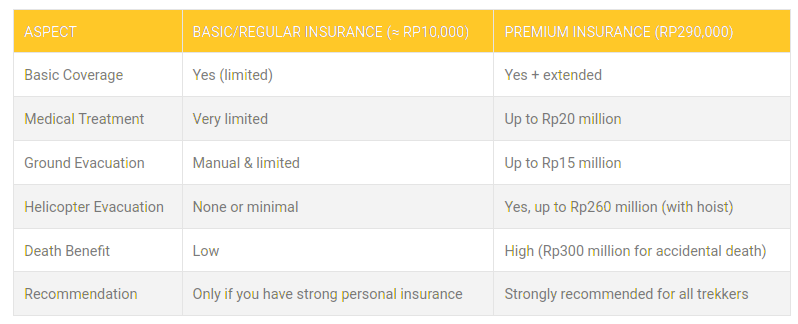
Note: Exact benefits may vary slightly depending on the official partner product in 2026. Always confirm the latest details when booking.
How to Obtain Premium Insurance
- During e-Rinjani ticket booking, you will see the option to select basic or premium insurance.
- If booking through a licensed trekking operator (guide + porter), they usually handle the process and payment together with your permit.
- If using personal insurance → prepare the provider name and policy number for registration.
- Payment is usually made together with the national park entrance fee.
Coverage is valid for a maximum of 4 days. Longer treks (rare) may require adjustment.
Partical Tips
- For Foreign Tourists (WNA): Strongly advised to purchase Premium because international evacuation and repatriation costs are much higher.
- For Indonesian Citizens (WNI): If you already have travel insurance or extended BPJS that covers high-altitude trekking and helicopter rescue, check first. Otherwise, add the Premium package.
- Beginners or those with health conditions: Definitely consider Premium + consult a doctor before the climb.
- Always keep proof of your policy (digital or printed) and share it with family and your guide.
Although Rp290,000 (approximately USD 17–18) feels expensive compared to the basic option, it is a small price compared to potential evacuation costs that can reach hundreds of millions of rupiah. Many experienced trekkers call this an “investment in peace of mind.”
